



Let’s start with a universal truth: you know those disruptive sales calls that shatter your focus?
The reflexive response for most is to disengage, to find the quickest exit. But as a communications leader, I’ve trained myself to do the opposite. I listen.
Not for the offer, but for the architecture of the pitch.
I track the exact moment my own attention vaporizes, and the pattern is flawless in its failure. It is the instant the script pivots from my problem to their company. The moment they stop trying to be the guide and start trying to be the hero.
This isn’t just a sales flaw. It’s a fundamental misunderstanding of the most important rule of strategic communication.
Deconstructing the Disconnect: The Two Pitches
This disconnect isn’t subtle; it is a complete structural failure. It’s the critical difference between a message that demands attention and one that earns it.
Let’s put the two models on the architect’s table.
Pitch 1: The Self-Focused Broadcast: This is the blueprint for failure. It’s built entirely on a foundation of “we” and “us.” It sounds like this: “We are the leading provider of X, we have Y awards, and we’ve serviced Z clients for 20 years.”
The fatal flaw?
It forces the audience to do all the cognitive labor.
The listener is left holding this pile of credentials, scrambling to figure out,
What does this have to do with me? Why should I care?
It is an act of communication arrogance, assuming your identity is more interesting to them than their own problems.
Pitch 2: The Problem-Focused Hook: This is the pitch that lands. It is built on “you” and “your.” It sounds like:
I’ve noticed you are likely facing [specific, well-researched problem], which is costing you [specific pain point]. We have a solution designed for this exact scenario.
The architecture of this message is superior because it delivers value before it asks for anything.
It demonstrates empathy and, more importantly, immediate relevance. It proves they understand your narrative, not just their own. They haven’t just bought a contact list; they’ve done the strategic work.
One sells a service. The other solves a problem. The first is noise; the second is a signal.
Just watch the first 60-90 seconds of the video below.
The Architect's Toolkit: How to Truly Know Your Audience
If the “Self-Focused Broadcast” is a product of laziness, the “Problem-Focused Hook” is a product of deliberate, strategic intelligence. Before you can architect a message that achieves, you must first architect a true understanding of the listener.
Your toolkit for this doesn’t need to be complex, but it should be rigorous!
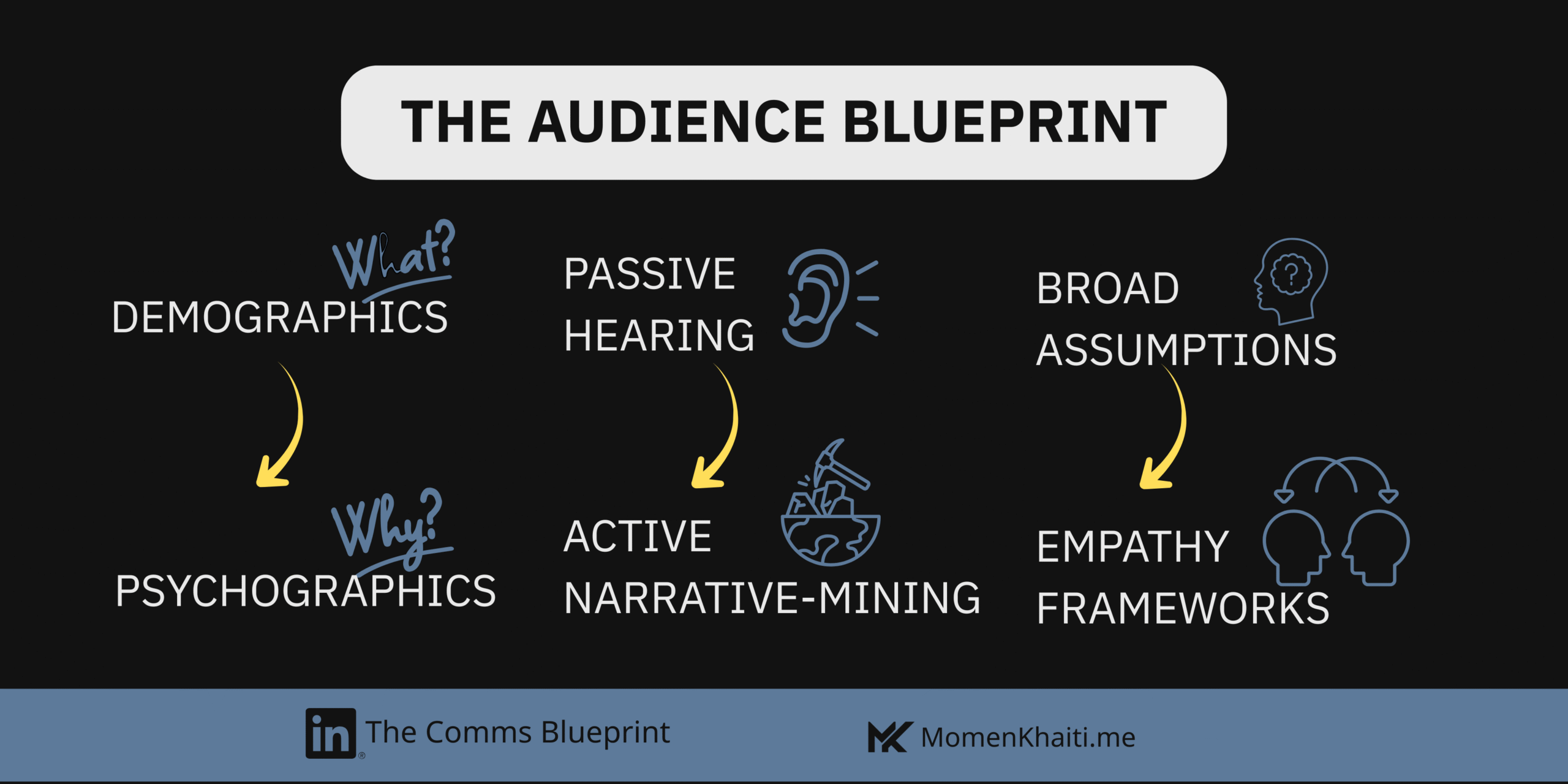
- Move from Demographics to Psychographics. Demographics tell you what they are (e.g., “Marketing Manager, 35-45”). Psychographics tell you who they are (e.g., “Overwhelmed by data, fears irrelevance, and is desperate for a clear win”). You don’t build a narrative for a job title; you build it for a human motivation.
- Practice Active Narrative-Mining. Stop just listening for pauses in the conversation to insert your talking points. Listen for the language they use. What words do they use to describe their problems? What questions do they really ask, versus the ones you wish they’d ask? As I did with those sales calls, I analyzed their “attention drops,” their objections, and their moments of excitement. These are your raw materials.
- Use Frameworks as Empathy Blueprints. Tools like “Empathy Maps” or the “Jobs to Be Done” (JTBD) framework are not academic exercises. They are practical blueprints for structuring your understanding. JTBD, for example, forces you to ask: What “job” is this person “hiring” my communication to do? Are they hiring it for reassurance, for status, for a quick solution? The answer dictates your entire message.
This toolkit shifts your perspective entirely. You stop being a seller of services and become a provider of solutions.
From Tactic to Strategy: Your Audience Is the Blueprint
This flawed, self-focused architecture is not an isolated incident. It is a systemic failure visible across the entire communications spectrum.
You see it in leadership messaging that centers on quarterly financial metrics while employees are worried about career progression and psychological safety.
You see it in brand marketing that shouts a long list of product features when the customer is just trying to solve a single, frustrating problem.
And you see it in internal communications that broadcast top-down corporate mandates but fail to ask:
What does this mean for your daily work?
In every case, the organization makes itself the hero. The result is the same: attention drops, engagement vaporizes, and trust erodes.
This is why the core thesis stands:
No communication strategy is successful without keeping the audience and their narrative at its core. Your audience is the blueprint. Their pains, their motivations, and their narrative are the only materials you should be building with.
Conclusion: Relevance Is the Only Currency
In an economy where attention is the real currency, relevance is the only way to earn it.
I could have started this article very differently. I could have opened with “I receive countless pitches as a communications leader, and I’ve noticed a pattern.”
But that would have been a self-focused broadcast.
It would have been a demand for your attention based on my credentials, forcing you to do the cognitive labor of connecting my observation to your own experience. It would have violated the very principle of the article.
Instead, I started with you and your universal experience with those disruptive calls.
Because the first rule of earning attention is to prove you understand your audience’s narrative before you ever ask them to listen to yours.
Stop trying to be the hero of your story. Your strategic objective is to be the indispensable guide in theirs.