



Most 2026 strategic plans are built on a flawed premise.
They are treated as linear roadmaps in a non-linear world. This is incorrect.
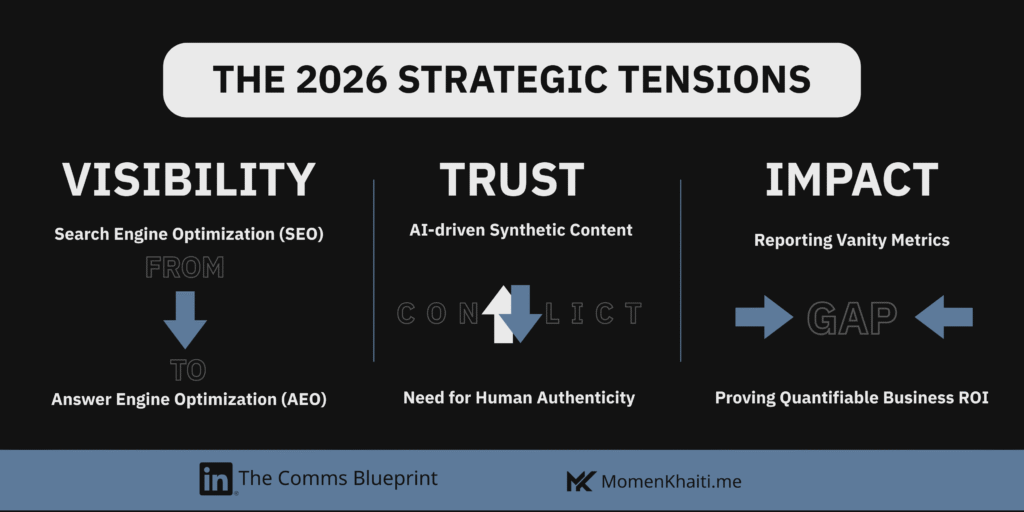
The 2026 communications strategy is not a plan. It is a dynamic model for managing three new, competing tensions.
This article deconstructs the core challenges that will define leadership visibility and C-suite influence for the next 24 months
The Visibility Crisis (From SEO to AEO)
For two decades, visibility meant ranking on Google. That era is over.
The new point of discovery is the AI-generated answer. Stakeholders, investors, and recruits no longer “search.” They ask.
If your narrative is not the basis for the AI’s response, you are invisible.
This is the shift from Search Engine Optimization (SEO) to Answer Engine Optimization (AEO). SEO targets keywords to win a click. AEO shapes a comprehensive narrative to win the AI’s summary.
Leaders risk losing control of their own story. Algorithms will define them based on outdated data, competitor content, or incomplete information.
The 2026 mandate is simple. You must proactively shape how AI systems interpret your content. You must ensure your leadership bios, company profiles, and strategic positions are the definitive source for the answers AI provides.
The Trust Paradox (Surviving the Synthetic Flood)
The second tension is a paradox. As AI adoption accelerates for efficiency, stakeholder trust is collapsing.
Research shows as much as 90% of online content could be synthetic by 2026.
This flood of AI-generated material, combined with sophisticated deepfake threats, erodes the believability of all corporate messaging.
In this environment, verifiable human authenticity becomes the most valuable asset.
Stakeholders do not trust automated systems. They trust people.
A 2026 strategy must move beyond simple automation.
It requires building “human-centered trust architectures.” This means establishing clear authenticity markers for all leadership communication.
It also means investing in employee advocacy, transforming your internal team into a network of trusted human messengers.
When the source is verifiable, the message lands.
The Impact Gap (From Vanity Metrics to Business Value)
The C-suite has a high demand for communications counsel. The research confirms 84% of leaders want this guidance.
There is a problem.
The communications function consistently fails to prove its business value. Teams still report on vanity metrics like impressions, clip counts, and share of voice.
These metrics are irrelevant. They do not correlate to business outcomes.
The 2026 strategy must close this impact gap. This requires building correlation models that link communications activity directly to the sales pipeline and conversion rates.
You must move from measuring “positive sentiment” to demonstrating how that sentiment precedes a 1.5% higher conversion rate 90 days later.
Leaders who cannot translate their team’s activity into quantifiable ROI will lose their budget. They will lose their influence.
Conclusion: The Architect's Mandate
The 2026 communications leader is not a trend-follower.
They are an architect.
Their mandate is to design the systems that actively balance the opposing forces of visibility, trust, and impact.
Success is not found in managing one. It is found in mastering the tension between all three.