


Introduction
There is a new sound in the halls of leadership.
It is the smooth, polished, and perfectly optimized hum of the generative AI engine.
It’s being used to draft executive emails, craft leadership memos, and script entire thought leadership platforms. The result is an undeniable surge in productivity.
But this efficiency has come at a high, and largely untalked-about, cost.
An entire class of executive communication is converging into a single, generic voice.
This ‘grey echo chamber’ of sameness isn’t just a stylistic problem. It is a critical, emerging strategic liability that erodes the single most valuable asset a leader has: a distinct, human voice.
And the most common solution being offered is entirely wrong.
The Strategic Cost of the Echo Chamber
This reliance on AI as a creator rather than a tool is creating three distinct and dangerous strategic costs.
1. The Erosion of Trust: Your audience is smarter than you think.
They are already developing a sixth sense for the rhythm of AI-generated text, which is the perfect cadence, the predictable structure, the absence of human friction.
Every time they encounter this “vanilla” voice where a human one should be, a micro-transaction of trust is broken.
Real influence is not built on perfectly polished content. Instead, it’s built on the human connection, perceived vulnerability, and specific point of view that AI is engineered to sand away.
2. The Dilution of Brand: In a crowded market, your brand’s unique perspective is its primary differentiator. The CEO’s voice is the most powerful asset for personifying that brand.
When that voice is outsourced to a machine optimized for consensus, it becomes generic by default.
The brand’s unique positioning is blunted, its sharp edges are smoothed over, and it slowly dissolves into the same grey noise as its competitors.
3. The Surrender of Advantage: This creates a second-order problem that is far more dangerous.
If your core insights are indistinguishable from those any competitor can generate with the same prompt, you no longer have a competitive advantage. You are simply racing to be the first to publish the same idea.
A distinct, human-led perspective is a deep “trust moat” that AI-driven competitors cannot easily replicate.
To surrender it for the sake of efficiency is a catastrophic unforced error.
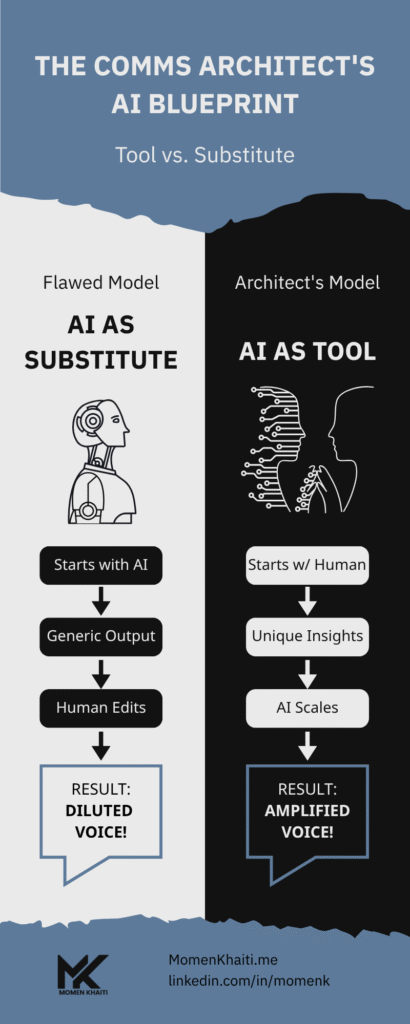
This is why the common solution, “just have a human edit the AI’s output“, is so fundamentally flawed.
Beyond "Human-in-the-Loop": Why Editing AI Isn't Enough
The most common advice offered to counter this problem is “use AI, but keep a human in the loop.”
This advice, while well-intentioned, is strategically flawed. It advocates for editing to polish the machine’s output.
This is a critical error.
Editing an AI’s text is not a strategy. It is merely curation.
It still forces the human to start from the machine’s generic, consensus-based foundation. You are, at best, adding a thin veneer of humanity to a fundamentally soulless core.
The real work of a Communications Architect is not in the polishing, but in the extraction.
The value is not in prompting the AI to “sound like a leader.” The value is in strategically defining and capturing the leader’s raw, unfiltered insights and unique worldview before the AI is ever activated.
The AI is a powerful tool, but its role is to scale a human-defined strategy, not to become a substitute for it.
Conclusion: The Architect's Blueprint for a Human Voice
The future of executive presence will not be defined by who uses AI most effectively.
It will be defined by those who can be the one thing AI cannot: distinct, opinionated, and authentically human.
Generative AI is a phenomenal tool for scaling a message, optimizing its delivery, and automating low-level tasks. However, it is a disastrous substitute for strategy, soul, and a unique perspective.
The true role of the Communications Architect is to build the blueprint first.
It is to extract the unique human insights from the executive and then deploy technology to amplify them.
Do not ask your AI to be your voice. Ask it to give your voice a microphone!