


Listen to this article:
The corporate world is obsessed with “authenticity.”
We are told to “bring our whole selves to work.”
Brands are advised to be “vulnerable.”
CEOs are encouraged to “share their scars.”
It sounds noble. It is actually becoming a strategic liability.
We have confused confession with connection.
We have mistaken performance for principle.
The result is a new and dangerous phenomenon: Authenticity Fatigue.
Your stakeholders are not looking for a friend; they are not looking for a confessional.
They are looking for a solution. They are tired of the performance; they just want the product to work.
Let’s deconstruct why the “be real” strategy is failing, and what you should build instead.
The Reality Check: The "Say-Do" Abyss
We have never been more transparent. Yet, we have never been less trusted.
The data proves this disconnect.
According to a recent PwC survey, 90% of business executives believe their customers highly trust them.
Only 30% of consumers actually do.
That is a 60-point delusion. It is the “Say-Do” Abyss.
Organizations are confusing activity with impact. They launch “listening tours” and “transparency portals”, thinking this builds bridges.
It does not.
The 2025 Edelman Trust Barometer characterizes the current landscape as a “crisis of grievance”.
When stakeholders feel economic pressure and systemic failure, they do not want to hear about your brand’s “journey.”
They want to know if you can do the job.
The Psychological Shift: Competence Over Warmth
Why is “authenticity” failing to close this gap?
The answer lies in the Stereotype Content Model, a psychological framework that explains how we judge trustworthiness.
Humans evaluate trust on two primary axes:
- Warmth: Your intent (Are you nice? Are you authentic?).
- Competence: Your ability (Can you execute?).
For the last decade, brands have over-indexed on “warmth”.
They prioritized “human” voices and emotional narratives.
But in a high-stakes environment, the hierarchy flips.
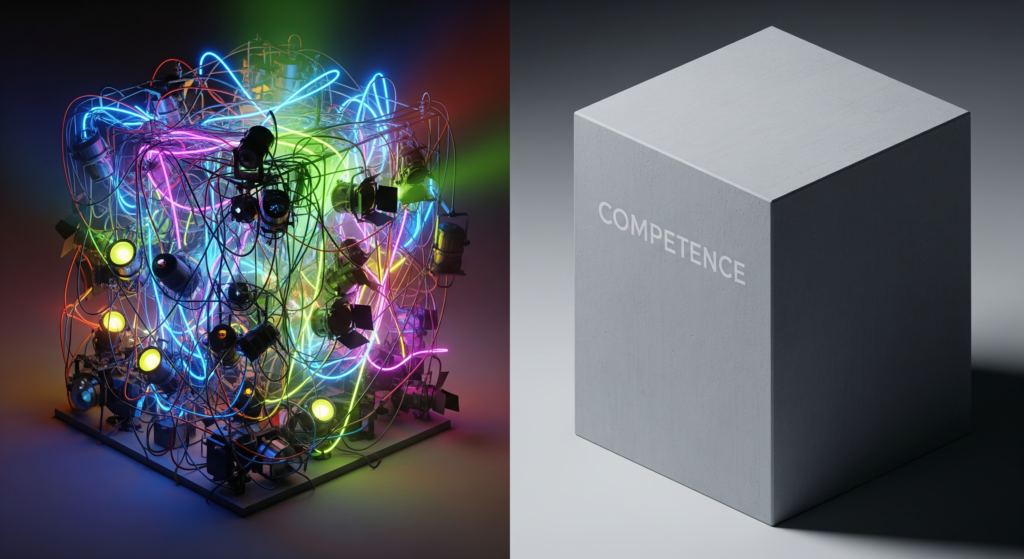
Research indicates that when performance is critical, Competence trumps Warmth.
If your logistics fail, an “authentic” apology on Instagram is not a strategy; it is an annoyance.
If your product breaks, a “vulnerable” CEO letter is not leadership; it is incompetence.
Your stakeholders have stopped asking, “Is this brand real?”
They are now asking, “Does this brand work?”
The Blueprint: Quiet Consistency
The antidote to Authenticity Fatigue is not more silence; it is Quiet Consistency.
This is the discipline of letting your systems speak louder than your social media team.
Consider the contrast between two modern brands:
The Trap: Oatly’s “F*ck Oatly” Campaign Oatly launched a website detailing its own scandals. It was hailed by marketers as “genius.” It was viewed by critics as performative narcissism.
By publicizing their legal battles without showing empathy for the small business they sued, the transparency felt like damage control, not accountability. It was “authenticity” as a shield to deflect criticism.
The Standard: Patagonia’s “Don’t Buy This Jacket” When Patagonia told people not to buy their products, sales went up.
This wasn’t a marketing trick. It worked because the brand had spent 50 years building a supply chain that supported that specific message.
They didn’t need to “perform” sustainability. Their operations were the sustainability.
Conclusion
In a world of deep fakes, AI-generated content, and corporate spin, your audience is craving something boring: Reliability.
Stop asking, “Is this authentic?” Start asking, “Is this consistent?”
Trust is not a feeling you evoke in a viral video. It is a reputation you earn through years of boring, competent execution.
Stop acting. Start delivering.