



The Efficiency Hangover
We spent the last three years in a race for efficiency. Corporate communications teams prioritized speed and volume above all else, flooding the zone with cheap content.
That strategy backfired. It generated a massive trust deficit across the market.
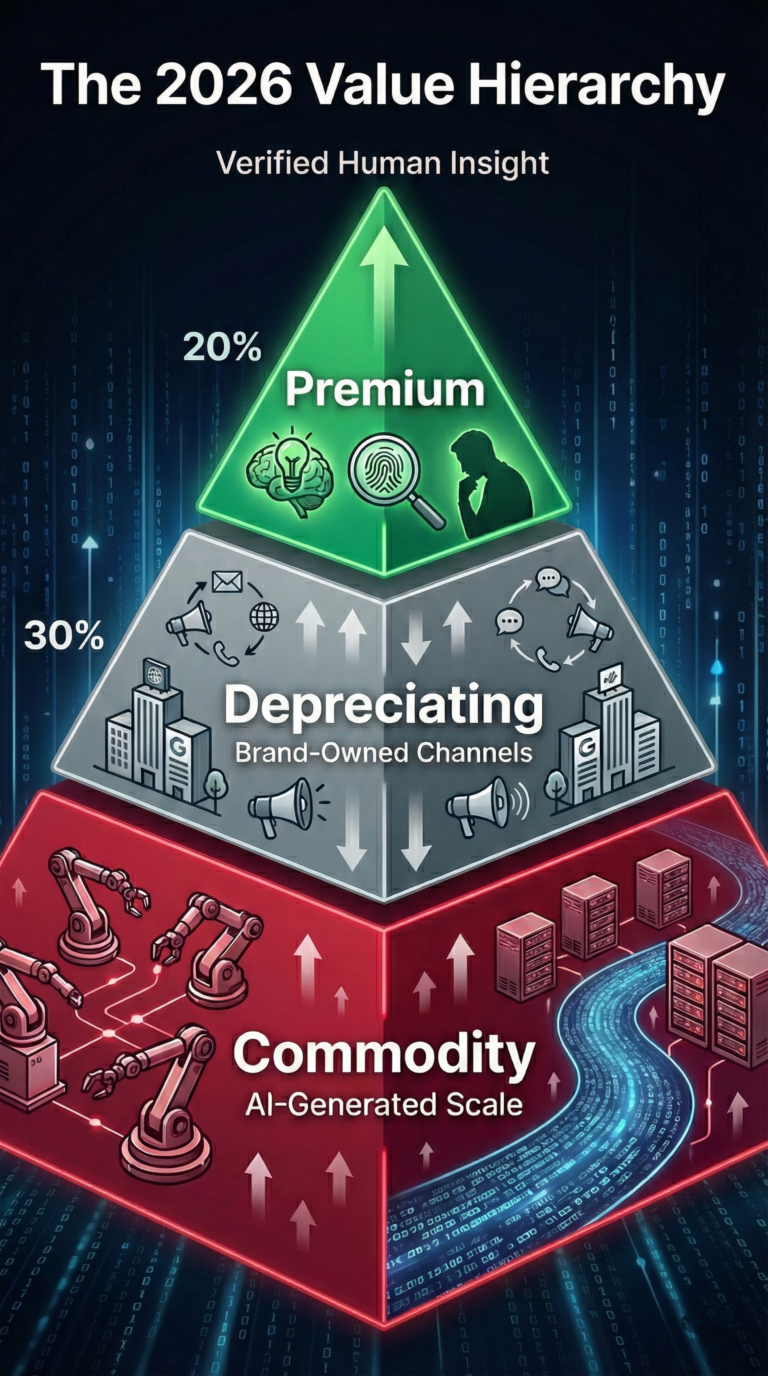
Audiences now view high-frequency, polished content as synthetic by default. This deep skepticism destroys the ROI of traditional owned channels.
Production costs dropped to zero, and the perceived value of that content collapsed alongside it. Rebuilding authority now requires a direct capital investment in verification.
Paying the "Verification Tax"
This shift represents a hard change in capital allocation. We call it the “Verification Tax.”
The data supports this financial reality. Forrester reports that enterprise spending on deepfake detection technology will grow by 40% in 2026. Similarly, Gartner projects that half of all enterprises will formally invest in “disinformation security” products by 2027.
These funds function as a defensive baseline. Companies must now pay a premium to prove their executive leadership is authentic. “Being human” has transitioned into a purchasable asset.
The Friction in the Market
Consequently, the traditional “Owned Channel” model is failing. Buyers view brand-owned handles with increasing skepticism.
B2B marketers are responding aggressively to this friction. We are seeing budgets swing proactively, with 75% of marketers increasing spend on influencers and human proxies.
Capital flows away from corporate logos and toward individual experts because third-party human validation outperforms first-party brand messaging. Market authority now resides exclusively with specific, verified individuals.
The Talent Shift
This new reality changes who we hire.
Recruiters previously hunted for “storytellers” who could polish narratives. In 2026, the mandate shifts toward “internal diplomats” and “subject matter experts” who can speak without a script.
We are moving away from back-office content generators. The high-value roles are now front-facing individuals capable of navigating live, unedited environments.
If a leader cannot communicate effectively in real-time, their value depreciates. The ability to speak unscripted is the new corporate literacy.
The Strategic Pivot
To survive this shift, brands must counter algorithmic noise with unscalable intimacy.
The winning strategy for 2026 prioritizes “High Touch” mechanics over “High Volume” distribution. Value is shifting toward live events, unscripted audio, and raw executive thought leadership.
These formats resist automation and prove human involvement immediately. In a world of perfect AI generation, “flaws” are now proof of life.
The “messiness” of real-time thinking acts as a competitive advantage that AI cannot replicate.
Strategic Implication
Start optimizing for verification. We architect communication strategies that survive the collapse of digital trust.