



The Cost of Pure Velocity
We spent the last few years chasing the ghost of frictionless efficiency. Boardrooms demanded speed at all costs, assuming that removing the human element would yield a leaner organization.
This pursuit of pure velocity resulted in a speed-quality paradox that now defines the current landscape.
Velocity is a liability without judgment.
Research from MIT indicates that 95% of enterprise AI pilots failed because they prioritized automation over oversight. Successful implementations do the opposite.
They design friction back into the workflow to protect accuracy and preserve context.
The Rising Trust Penalty
This operational hangover coincides with a fundamental shift in audience psychology. The 2026 Edelman Trust Barometer reveals that 70% of the global population now operates with an insular mindset.
People are instinctively skeptical of any communication that feels automated or generic. When a leader uses AI to draft emotional or high-stakes messages, the audience detects a lack of authenticity.
This triggers what researchers call the AI-authorship effect, which is a form of moral disgust that actively erodes brand loyalty and executive credibility.
Credibility cannot be outsourced to machines.
The Recruitment of Synthesis
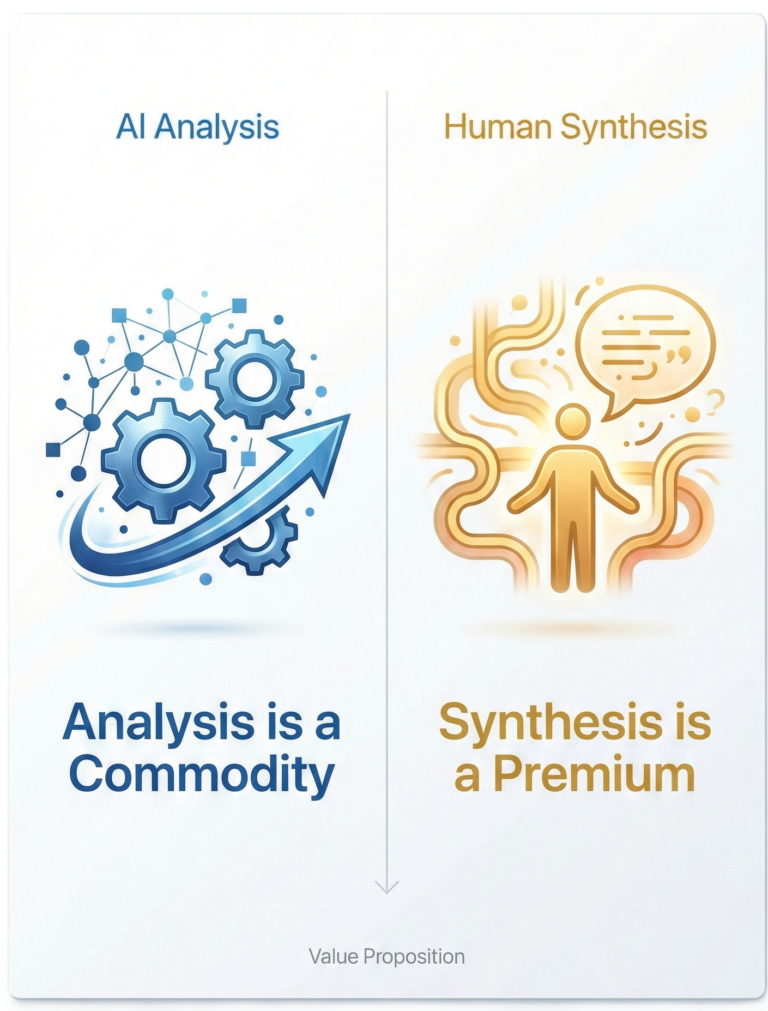
These shifts are fundamentally changing what it means to be a high-value hire. Technical proficiency has become a baseline commodity rather than a competitive advantage.
Recruiters are now searching for a much rarer capability known as narrative intelligence. This is the human ability to synthesize conflicting truths into a coherent strategy.
While machines are excellent at analysis, they lack the lived experience required to build consensus across a divided workforce. Leaders who can bridge the gap between data and human meaning are commanding a significant premium.
Analog as a Strategic Differentiator
Because the digital space is now saturated with low-cost noise, physical presence has emerged as a luxury positioning tool. Choosing to show up in person is no longer a legacy constraint.
It is a clear signal of authority and commitment. The financial results of this “Analog Premium” are substantial.
Research shows that face-to-face meetings can generate a 36% revenue premium compared to virtual alternatives.
Furthermore, in-person interactions result in 37% more closed deals. Trust is built in the friction of real-world interaction.
Reclaiming the Trust Broker Role
The organizations winning in 2026 are those that know when to slow down. They treat human judgment as a scarce resource and narrative as a strategic asset.
By re-introducing intentional touchpoints, these leaders are reclaiming the trust that automation signed away. High-touch relationship models are winning against scale-optimized alternatives.
Effective leadership in a high-context world requires a blueprint for intentional engagement. If your organization is struggling to maintain credibility in a saturated market, it is time to conduct a Strategic Friction Audit.