



The Invisible Orchestra
Benjamin Zander conducted for 20 years before realizing a critical truth. The conductor makes no sound.
His power doesn’t come from his own voice, it comes from awakening possibility in others.
Your communication infrastructure must act as this invisible conductor.
Here is the problem:
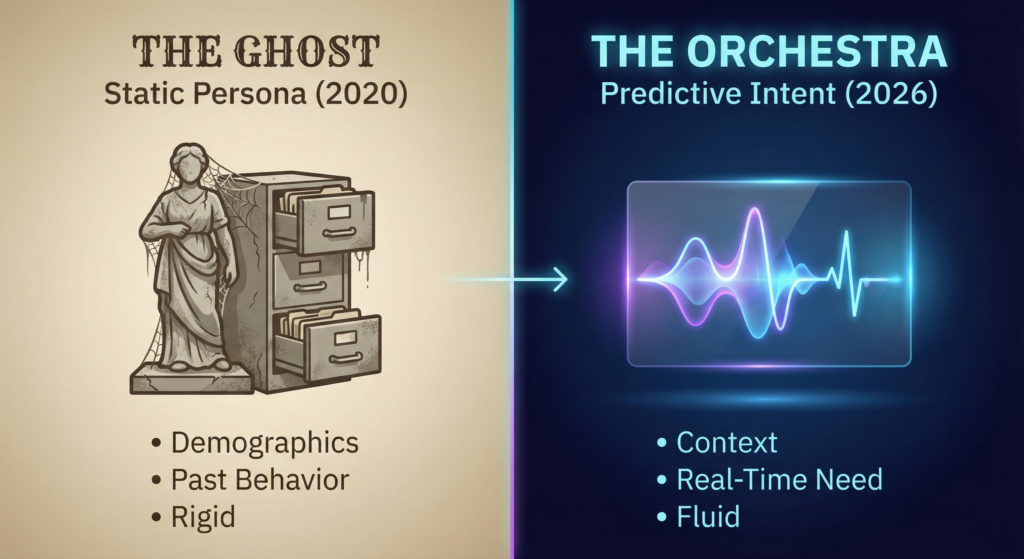
Most strategies still rely on “static personas.” Leaders treat audiences as fixed data points based on past behavior.
In the algorithm-driven landscape of 2026, this is a liability.
Static profiles fail to capture the living, breathing context of the human behind the screen. It is time to replace rigid structures with predictive intent.
Why Static Personas Cost You Money
Static personas are comfortable. They are also expensive.
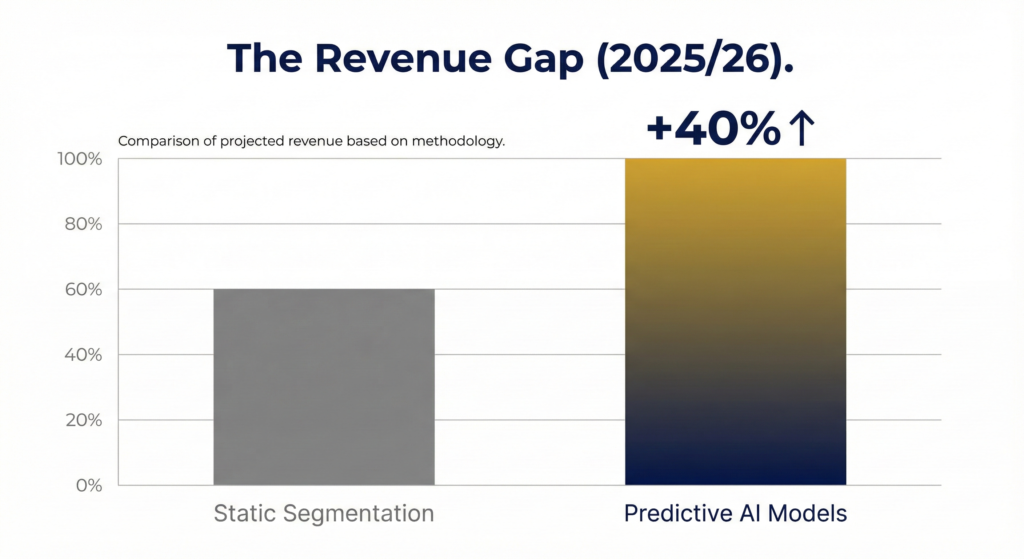
Recent data reveals a stark reality. Organizations deploying hyper-personalization strategies are now generating 40% more revenue than competitors relying on basic segmentation.
The difference is structural.
Static segmentation looks at who a person was. Predictive modeling looks at who a person is becoming in real-time.
Companies switching to predictive intent modeling are seeing conversion rates climb by 20–30% while simultaneously reducing customer acquisition costs.
The market has shifted. If you are still marketing to a fixed identity, you are marketing to a ghost.
Context as the Primary Signal
Demographics tell you who someone is, context tells you what they need right now.
Consider L’Oréal’s recent shift in strategy.
They moved away from targeting the static “beauty buyer” persona.
Instead, they deployed an AI ecosystem to detect real-time environmental signals like local UV levels and pollution indices.
When the air quality dropped, the messaging instantly pivoted to protection and hydration.
The results were immediate.
They achieved a 10x uplift in Return-on-Ad-Spend and a 46x increase in engagement.
This is the “Predictive Intent” model in action.
It ignores the resume and reads the room.
By treating the user’s immediate context as the primary signal, you move from interrupting their day to solving their immediate problem.
Engineering Emotional Resonance
Most brands train their copywriters to speak in a consistent “brand voice.”
This is a mistake.
A static voice fails when the customer’s mood shifts.
Virgin Holidays proved this when they deployed AI to rewrite their email subject lines.
They didn’t just test words, they tested emotions.
The AI analyzed response patterns to predict which tone, whether it’s urgent, curious, or friendly, would trigger a specific user at a specific moment.
The result was a 2% increase in open rates.
That small percentage translated into millions in incremental revenue.
Human writers, bound by static guidelines, missed these nuances. The AI did not.
The lesson is clear.
We are moving from “demographic targeting” to “emotional engineering.“
You must stop asking what your customer is. Start asking how they feel.
Conclusion
True leadership is not about being the loudest voice, it is about serving the music makers.
Your audience, employees, clients, stakeholders, are the ones playing the instruments. Your role is to provide the invisible structure that allows them to perform.
In 2026, that structure is predictive.
It adapts to their needs before they articulate them. It delivers the right context, in the right tone, at the exact moment of intent.
When you master this, you stop making noise. You start making music.