



Listen to this article:
The conventional advice for personal branding is simple: “Be everywhere.”
We are told that visibility requires a presence on every new platform. This advice is wrong. It is a recipe for burnout, not impact.
The reality is that omnipresence is a trap. It forces you to recycle content, adopt multiple platform tones, and dilute your core message. Your brand voice becomes fragmented. Your resources are stretched thin. Your audience grows fatigued from the noise.
This strategy mistakes high volume for high value.
True authority is not built by shouting everywhere. It is built by speaking with precision in the places that matter. The most effective communicators do not chase every platform. They choose the right ones.
Strategic absence is more powerful than tactical noise.
The High Cost of Digital Noise
An omnipresence strategy is not just inefficient. It is actively damaging.
When a brand posts recycled content across five or more platforms, engagement does not multiply. It fractures. Audience fatigue is a measurable cost. Reports show 81% of consumers have unsubscribed from brands that post too often or cross-post irrelevant content.
This approach also dilutes your most valuable asset: your brand voice.
A message crafted for the professional context of LinkedIn cannot be copied to a fast-moving visual platform without losing its integrity. The attempt to be everywhere forces a brand into a state of permanent inconsistency.
Internally, this strategy leads to team burnout. The workflow required to maintain a presence on every channel is immense. It slows down production, exhausts creative resources, and results in the exact low-quality, repetitive content that algorithms and audiences both penalize.
The ROI of Strategic Focus
The alternative to digital noise is strategic focus. This approach delivers measurable returns.
Data shows that for B2B and executive brands, LinkedIn remains the primary channel. 98% of Fortune 500 CEOs use it. This is where professional credibility is built and where decision-makers invest their attention.
A high-focus strategy allows for depth. Instead of spraying generic content everywhere, you can build a deep, defensible community on one or two core platforms. This is how true influence is established.
Consider the case of B2B leaders who build multi-million dollar businesses primarily on LinkedIn. They achieve this by mastering a single platform’s ecosystem, not by being mediocre on ten. They invest in sustained, high-quality dialogue.
This focus is an investment in trust. It signals to your audience that you are not just broadcasting, but are present to engage. This is an outcome omnipresence can never achieve.
An Architect's Blueprint for Platform Selection
Strategic selection is an analytical process. It replaces the impulse for omnipresence with a framework built on evidence.
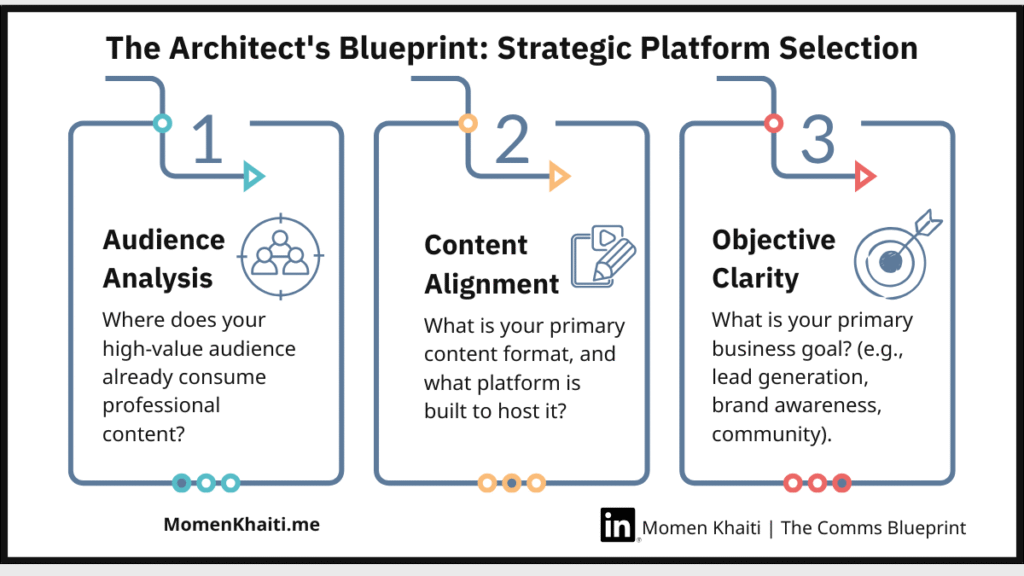
Your platform choice should not be based on trends. It must be a deliberate decision based on three pillars.
First, Audience Analysis. Where does your specific audience—your clients, your stakeholders, your potential recruits—actually consume professional content? Go where your high-value audience is already concentrated.
Second, Content Alignment. What is your primary content format? If you build authority through detailed analysis, a long-form platform like LinkedIn or a blog is your foundation. If your strength is rapid-fire insights, X (Twitter) may be a primary channel. Do not force your content onto a platform that does not fit.
Third, Objective Clarity. What is your goal? Is it lead generation, brand awareness, or community building? Each platform serves a different business objective. A platform for broad awareness is not always the correct one for building a deep, high-trust community.
If a platform does not satisfy all three of these filters, you do not need to be there.The 3-Pillar Framework for strategic platform selection. Use this blueprint to filter out noise and focus your efforts.The 3-Pillar Framework for strategic platform selection. Use this blueprint to filter out noise and focus your efforts.
Conclusion: Stop Broadcasting. Start Resonating.
The ‘be everywhere’ strategy is a relic. It was designed for an older internet, one that rewarded volume above all else.
That era is over.
Today, authority is built on clarity, consistency, and depth. Your audience does not want more noise from you; they want more value. This is impossible to deliver when your focus is fragmented across a dozen platforms.
Stop broadcasting. Start resonating.
Choose your channels with strategic intent. Master them. Go deep. This is how you move from being just another voice in the crowd to being the voice your audience trusts.