


Introduction: The "Google Translate" Trap
Let’s be honest about the state of global communication in our region.
Too many brands still treat Arabic as a plugin.
They build a strategy in English, then hand it over for Arabization at the eleventh hour.
This is not a strategy; it is a liability.
The data is unequivocal: 87% of consumers in Saudi Arabia prefer content in their native language.
Yet, we continue to see major players fumble their market entry because they confuse translation with connection.
They assume that if the words are correct, the message is clear.
As a Communications Architect, I can tell you that correct is often the enemy of resonant.
In a region defined by nuance, treating language as a feature rather than infrastructure is a strategic error.
It’s time to stop translating and start designing.
The "Silent" Risk (Crisis & Context)
A message can be linguistically perfect and strategically catastrophic.
Context is the invisible variable that machine translation cannot see.
Consider the recent case of Pepsi in Egypt.
In 2024, the brand launched a campaign with the slogan Stay Thirsty (خليك عطشان).
Linguistically, it was a standard, energetic marketing hook.
Contextually, it was a disaster!
The campaign launched precisely when Palestinians in Gaza were suffering severe water shortages.
The backlash was immediate.
Consumers interpreted the slogan as mocking a humanitarian crisis, leading to massive boycotts and double-digit volume decreases.
Local competitors like SinaCola immediately seized the narrative with counter-campaigns.
The lesson is sharp: Your reputation is not protected by grammar; it is protected by situational awareness.
In the Middle East, a deaf brand is a dead brand.
Architecture vs. Decoration (Structural Strategy)
True localization is structural, not cosmetic.
It is the difference between an architect and an interior decorator.
Compare the market entry strategies of two global giants: Alibaba and Amazon.
Alibaba entered the region relying heavily on machine translation. They treated the market as a digital extension, effectively decorating their existing framework with Arabic keywords.
The result? User friction, distrust, and a perception of being foreign.True localization requires structural commitment.
Amazon took a different path. They didnt just translate; they acquired architecture.
By buying Souq.com, they purchased established logistical rails, local payment integrations, and deep behavioral data.
They understood that you cannot simple “port” trust from one culture to another.
They built a bilingual infrastructure that respected local nuances—from cash-on-delivery preferences to specific delivery logistics.
The “Architect” mindset accepts a hard truth:
You cannot build a localized reputation on a generalized foundation.
The 2025 Standard (Dialect & Mobile)
The era of One Arabic is over.
Consumers in 2025 demand hyper-localization, not generic broadcasting.
Research indicates that 67% of UAE consumers remain loyal to brands that communicate in their specific local dialect.
Trust is no longer built in Modern Standard Arabic (MSA) alone; it is built in the vernacular of daily life.
This is the core of the Two-Tone strategy.
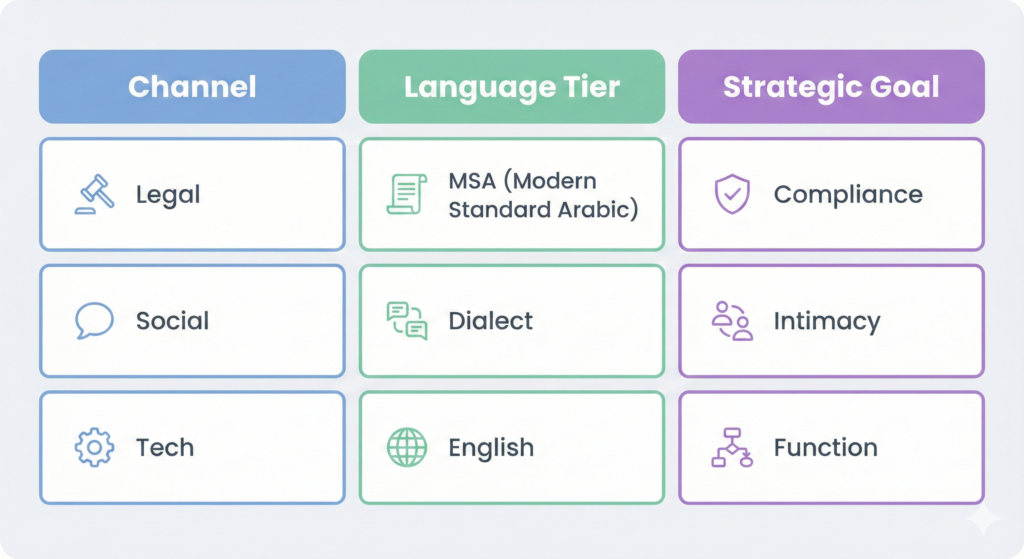
It requires a disciplined framework for determining which lever to pull:
English: Use for technical specifications and global partnerships.
Modern Standard Arabic (MSA): Use for official government communications, legal disclaimers, and formal corporate announcements.
Local Dialect (Khaleeji/Egyptian/Levantine): Use for social media, community engagement, and emotional storytelling.
On a mobile screen—where 75% of web traffic in the UAE originates—intimacy wins.
Dialect creates that intimacy. Formal Arabic creates distance.
A Communications Architect knows exactly when to bridge that gap.
Conclusion: The Currency of Respect
Language is logic. Culture is currency.
You can buy translation, but you must earn resonance.
As you review your Q1 communications plan, I challenge you to audit your assets not for linguistic accuracy, but for “cultural latency.”
Are you speaking to a market, or are you speaking with a community?
The difference is your margin.